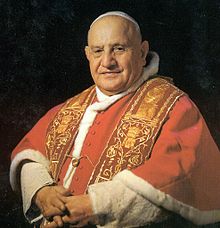
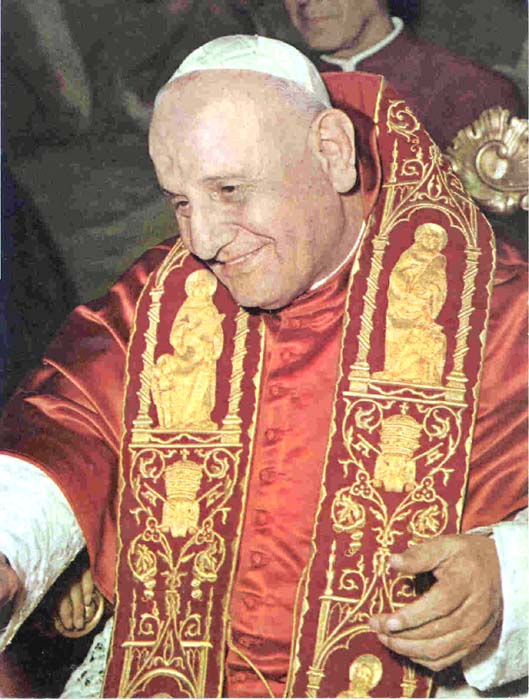
 St. John XXIII Angelo Guiseppe Roncalli Pope N. 261 – 1958-1963 Papal Shield – Obedience and Peace Liturgical feast: October 11
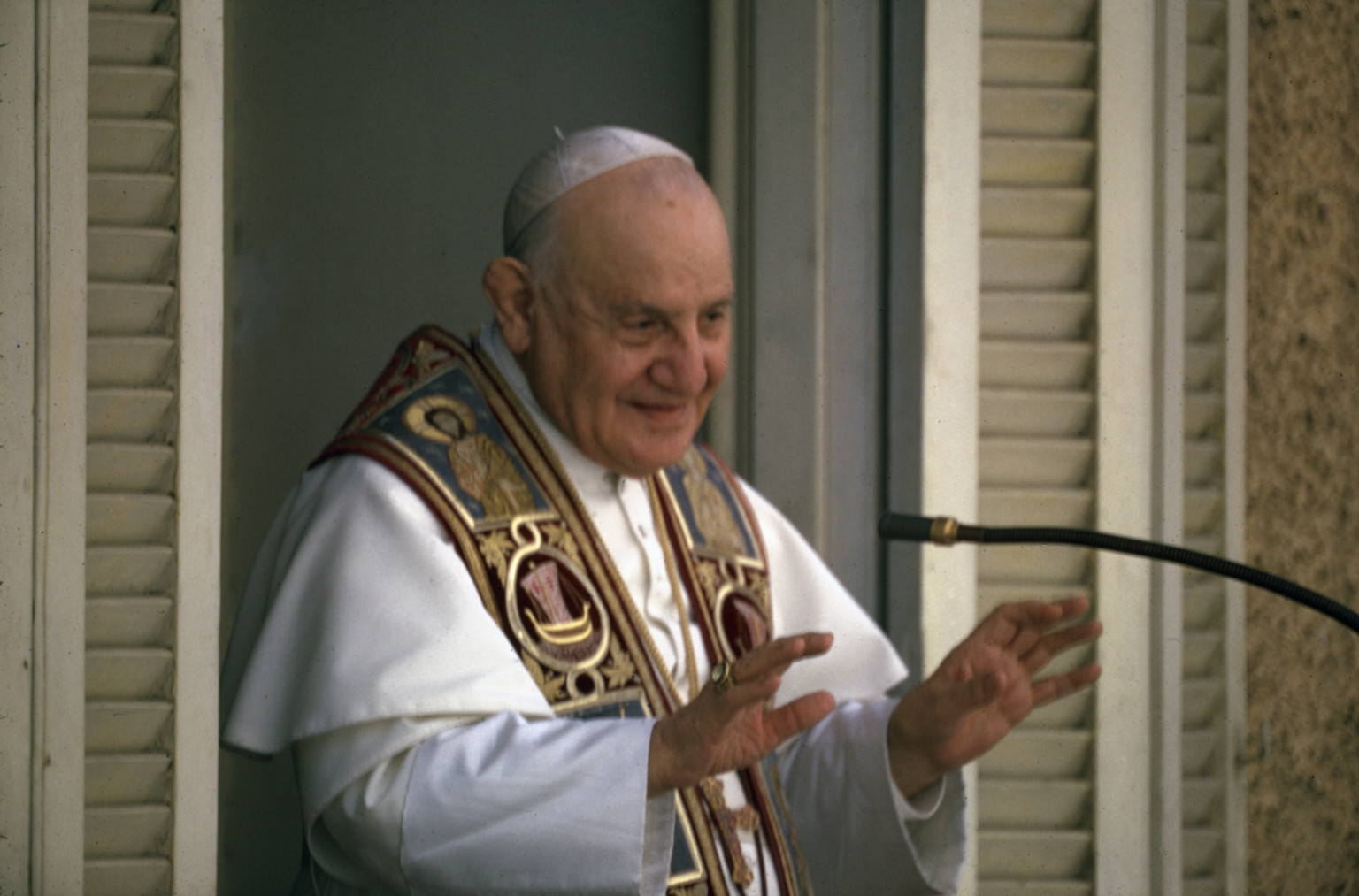 "Consult not your fears but your hopes and your dreams. Think not about your frustrations, but about your unfulfilled potential. Concern yourself not with what you tried and failed in, but with what it is still possible for you to do." Pope St. John XXIII
St. John XXXIII, Angelo Giuseppe Roncalli was canonized on April 27, 2014 on the Second Sunday of Easter by Pope Francis 1 at St. Peter's Basilica in Rome. In his homily, Pope Francis I remarked, "In convening the Council, John XXIII showed an exquisite openness to the Holy Spirit. He let himself be led and he was for the Church a pastor, a servant-leader, led by the Spirit. This was his great service to the Church; he was the pope of openness to the Spirit."
The United States Conference of Catholic Bishops invited writers, scholars and theologians to offer their reflections and perspectives on this beloved pope. Thanks to the USCCB and to Loyola Press for providing rich resources on the life of this historical pope.
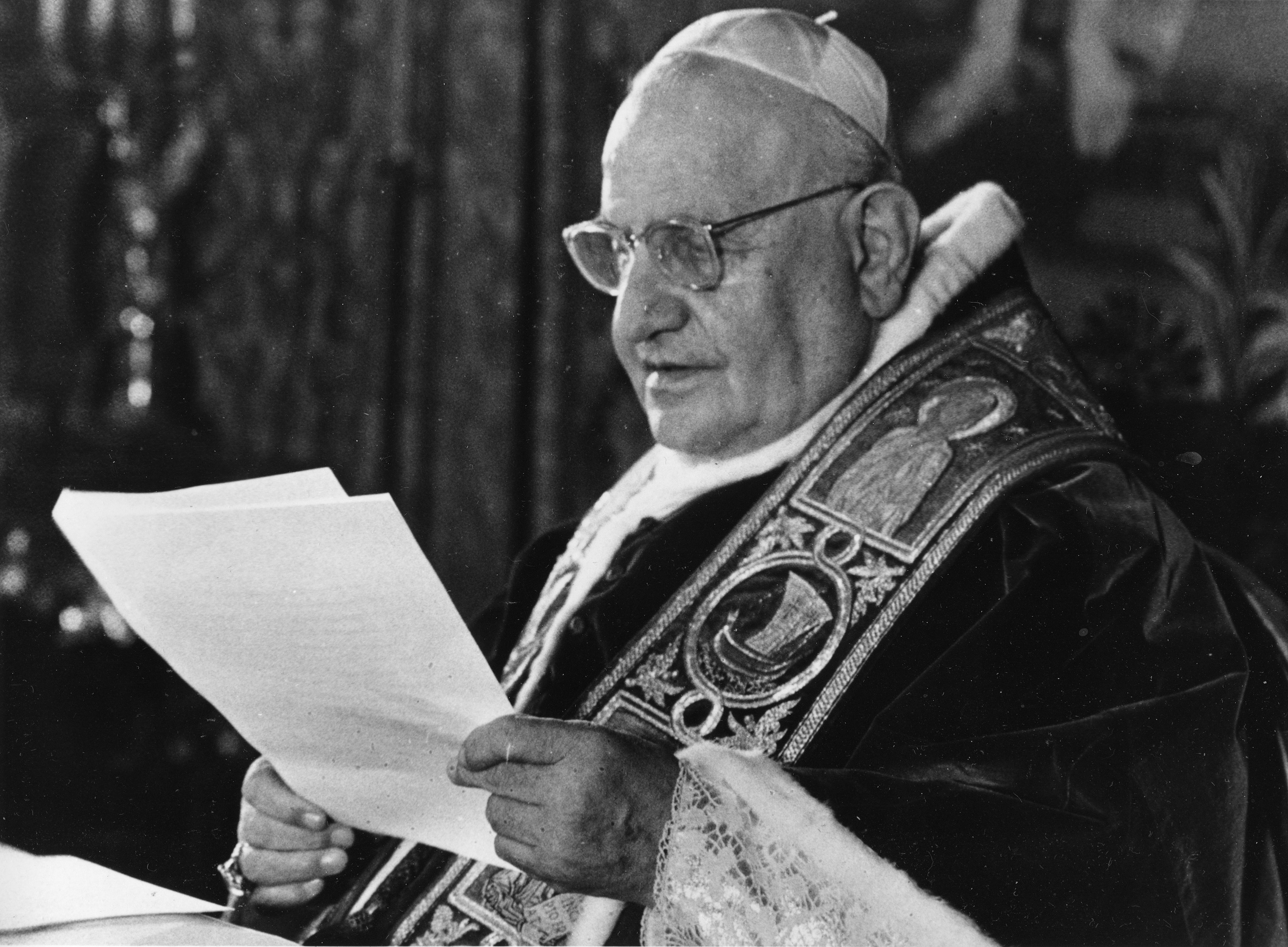 The staff of the Roncalli Center echoes Pope John XXIII magnificent opening address at the start of the Second Vatican Council: Gaudet Mater Ecclesia! (Rejoice, Mother Church!) Blessed John XXIII, our beloved "Papa Roncalli" has taken his place among the communion of saints.
We continue to pray with Pope John XXIII that the work of the Second Vatican Council continues to breathe the Spirit of God upon the Church and into the hearts of all humankind and "look to the future without fear."
"The Council now beginning rises in the Church like daybreak, a forerunner of most splendid light. It is now only dawn. And already at this first announcement of the rising day, how much sweetness fills our heart."
"To Jesus Christ, our most amiable Redeemer, immortal King of peoples and of times, be love, power and glory for ever and ever. Amen."
New release: Documentary on John XXIII
The Roncalli Center - Vision, Purpose and Means
The Roncalli Center provides liturgical education, ministerial formation and spiritual development for the ongoing renewal in the spirit of the Second Vatican Council. The Roncalli Center explores the intersection of faith, culture and reason by educating the mind and heart for evangelization and aggiornamento, a word used by St. John XXIII that means 'to bring up to date.'
Evangelization and aggiornamento summon us to integrate liturgy and life, animate theological reflection and mystagogy on liturgical praxis and rejuvenate the practice and prayerful reflection of sacramental mysteries.
The Roncalli Center is rooted in the study, discussion and implementation of the documents of the Second Vatican Council. Through liturgies, seminars, lectures, retreats, interdisciplinary programs, conferences and other initiatives, the Roncalli Center invigorates faith in the service of the Church.
The Second Vatican Council - A bit of history
Fifty years ago, John XXIII astonished the Church and the world when he followed the movement of the Spirit of God and called together the Second Vatican Council several months into his papacy. He called for a new way of being 'church', reflecting his own pastoral approach and invited inclusiveness, forgiveness, unity and reconciliation. Christian joy and hope underlined his message of the call to holiness through baptism in the Lord Jesus Christ.
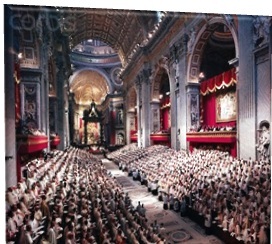 The Second Vatican Council changed the way Catholics celebrated the liturgy. People could now worship God in their own language. Altars turned around. The presider now faced the assembly to gather the prayer of the church in full, conscious and active participation in both spoken and sung prayer in their own native language rather than worship celebrated completely in Latin. Musicians created new compositions that encouraged the assembly's participation in sung prayer. Catholics could now receive Eucharist in a fuller expression in bread and cup. Interfaith conversations sprang up in an ecumenical spirit of prayer and effort for the common good. A well informed conscience became a freeing agent for individuals, a place between each person's heart and God, where no person can control or interfere. The people of God worked collaboratively within a scriptural, theological and liturgical based church. Regard for diversity raised religious liberty to new heights as awareness of the many paths to God were acknowledged. Community, culture and customs created a new way of being as the fresh air of the Spirit of God blew a refreshing wind of change through the prophetic documents and teachings of the Second Vatican Council.
With changes come questions. In the early 1960's, a young priest responded to the need of the people in his parish to understand the liturgical changes and the theology behind the Second Vatican Council. Fr. Roger Levesque formed faith formation groups called Living Room Dialogues at St. Anne's Parish in New Bedford. Fr. Roger met with groups of adults to explain the changes, their implications and answer their many questions of the thriving parish that also included a Catholic school. Just like the early Christians, families took turns hosting Father Roger and shared many evenings of prayer, vibrant dialogue and discussion. The parish became educated about liturgical practices while deepening their faith that rippled through many generations of St. Anne's parishioners. Because of Fr. Levesque's efforts, the parish fostered vocations to the religious life, ordained ministry and lay ecclesial ministry. The seeds of faith were planted through Fr. Roger's ministry and many other priests and faithful lay people who worked to labored in the Lord's vineyard in the years following the Council. Now is the time to harvest the fruit of that labor.
 The Roncalli Center, named for Angelo Giuseppe Roncalli and otherwise known as Blessed Pope John XXIII began Living Room Dialogues on October 23, 2012. Together, we continue to build community and revisit what the Second Vatican Council envisioned. We look at how we pray, how we worship, preside, sing, preach and invite new dialogue that informs our Christian faith in this time and place.
Just as the members of the Council cried 'Adsumus' (We are present!) at the beginning of each session, the Roncalli Center invites you to be present to this new endeavor by joining your voice to the dialogue in the faith tradition of the early Christian church. This is a time of a new advent of enthusiasm, interest and involvement as the Spirit makes itself known, alive and active in a new zeal of energy to revitalize the people of God and set the world ablaze with God's love through the person of Jesus Christ. This is our church, our faith, our witness.
On the evening of the opening of the Second Vatican Council, Pope John XXIII appeared outside of his apartment window and spontaneously addressed the people gathered in St. Peter's Square. "When you return home you will find your children: Caress them and tell them: 'This is a caress from the Pope.' You will find some tears to dry. Speak words of comfort fo the affliected. Let the afflicted know that the Pope is with his sons and daughters, especially in hours of sadness and bitterness." History of Vatican II, Volume I, The Formation of the Council's Identity, eds. Giuseppe Albergio, Joseph A. Komonchak (NY, NY: Orbis, 1997), 20.
Click on the links below to read a few short, poignant pieces on The Second Vatican Council. Thanks to America Magazine for providing public blogs that keep us informed. Find them at http://americamagazine.org/ For further reading, click on the About and Links tab on our home page for some great resources.
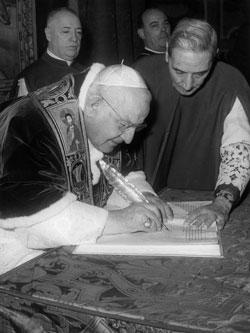 What happened at Vatican II. Avery Dulles, John W. O'Malley. Article courtesy of America Magazine blog. http://americamagazine.org/issue/100/what-happened-vatican-ii
Vatican II: The Myth and the Reality by Avery Dulles. Article courtesy of America Magazine blog. http://americamagazine.org/node/146399
Misdirections by John W.O'Malley. Article courtesy of America Magazine blog. http://americamagazine.org/issue/article/misdirections
Inside Vatican II
On February 21, New Evangelization Television (NET) began a ten-part video series called Vatican II: Inside the Vatican Council. The series includes rarely-seen footage of the Council as it examines the history of the largest meeting in the history of the Church as well as the Council itself. How did the Second Vatican Council shape the Church as we know it today? Click the link and watch full episodes here Inside Vatican II.
Gaudet Mater Ecclesia - Opening Address of John XXIII of the Second Vatican Council
John XXIII encyclicals and other writings
Journey of a Soul The Autobiography of Pope John XXIII "Friendliness, serenity and imperturbable patience! I must always remember that 'a soft answer turns away wrath.' (Proverbs 15:1) What bitterness is caused by a rough, abrupt or impatient manner! Sometimes the fear of being underestimated as perso of little worth temps tus to give ourselves airs an assert ourselvs a little. But this is contrary to my nature. To be simple, with no pretentions, requires no effort from me. This is great gift that the Lord has bestowed on me: I want to preservie it and to be worthy of it." (Page 279)
“We deem it opportune to remind our children of their duty to take an active part in public life and to contribute toward the attainment of the common good of the entire human family as well as to that of their own political community. They should endeavor, therefore, in the light of their Christian faith and led by love, to insure that the various institutions—whether economic, social, cultural or political in purpose—should be such as not to create obstacles, but rather to facilitate or render less arduous man’s perfecting of himself in both the natural order and the supernatural.... Every believer in this world of ours must be a spark of light, a center of love, a vivifying leaven amidst his fellow men. And he will be this all the more perfectly, the more closely he lives in communion with God in the intimacy of his own soul.” Peace on Earth: Pacem in Terris
Constitution on the Sacred Liturgy (Sacrosanctum Concilium)
INTRODUCTION
1. This sacred Council has several aims in view: it desires to impart an ever increasing vigor to the Christian life of the faithful; to adapt more suitably to the needs of our own times those institutions which are subject to change; to foster whatever can promote union among all who believe in Christ; to strengthen whatever can help to call the whole of mankind into the household of the Church. The Council therefore sees particularly cogent reasons for undertaking the reform and promotion of the liturgy.
2. For the liturgy, "through which the work of our redemption is accomplished," most of all in the divine sacrifice of the Eucharist, is the outstanding means whereby the faithful may express in their lives, and manifest to others, the mystery of Christ and the real nature of the true Church. It is of the essence of the Church that she be both human and divine, visible and yet invisibly equipped, eager to act and yet intent on contemplation, present in this world and yet not at home in it; and she is all these things in such wise that in her the human is directed and subordinated to the divine, the visible likewise to the invisible, action to contemplation, and this present world to that city yet to come, which we seek. While the liturgy daily builds up those who are within into a holy temple of the Lord, into a dwelling place for God in the Spirit , to the mature measure of the fullness of Christ at the same time it marvelously strengthens their power to preach Christ, and thus shows forth the Church to those who are outside as a sign lifted up among the nations under which the scattered children of God may be gathered together, until there is one sheepfold and one shepherd.
3. Wherefore the sacred Council judges that the following principles concerning the promotion and reform of the liturgy should be called to mind, and that practical norms should be established.
Among these principles and norms there are some which can and should be applied both to the Roman rite and also to all the other rites. The practical norms which follow, however, should be taken as applying only to the Roman rite, except for those which, in the very nature of things, affect other rites as well.
4. Lastly, in faithful obedience to tradition, the sacred Council declares that holy Mother Church holds all lawfully acknowledged rites to be of equal right and dignity; that she wishes to preserve them in the future and to foster them in every way. The Council also desires that, where necessary, the rites be revised carefully in the light of sound tradition, and that they be given new vigor to meet the circumstances and needs of modern times.
Other resources about Pope St. John XXIII
My Heart Speaks: Wisdom from Pope John XXIII
I Will Be Called John by Laurence Elliott
A Joyful Soul: Messages from a Saint for Our Times
An Artist and a Pope by Curtis Bill Pepper
Pope John XXIII: Essential Writings
Good Saint John XXIII by Brother Mickey McGrath, OSF